
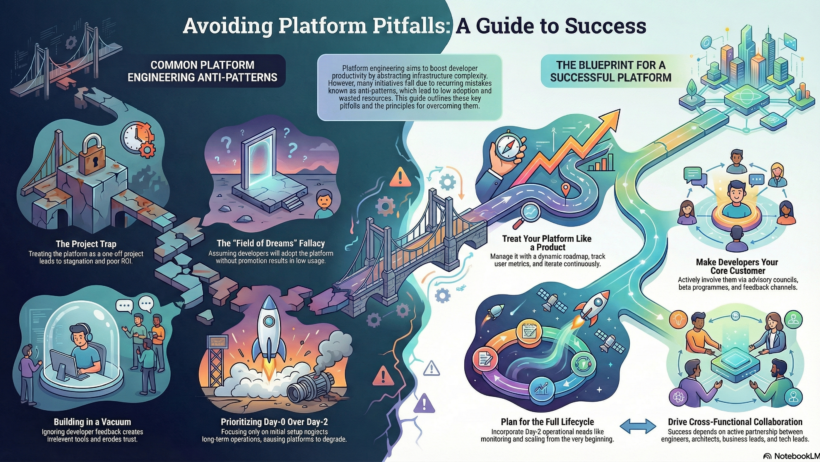

Platform engineering is revolutionizing how organizations build and maintain Internal Developer Platforms (IDPs), enabling developers to focus on innovation by abstracting away infrastructure complexities. These platforms promote self-service, standardization, and efficiency, but success isn’t guaranteed. Many initiatives stumble due to common anti-patterns—recurring mistakes that lead to low adoption, escalating costs, and organizational friction.
Drawing from insights in resources like the Team Topologies book, PlatformCon discussions, and lessons from pioneers like Spotify and Netflix, this post explores 10 key anti-patterns. For each, I’ll provide a detailed explanation, followed by expanded bullet-point strategies for avoidance (proactive prevention during planning), remediation (fixing existing issues), and mitigation (ongoing safeguards to prevent recurrence or minimize impact). These strategies are designed to be actionable, with step-by-step guidance to help teams implement them effectively.
Finally, we’ll delve into the roles of key stakeholders—platform engineers, architects, business leads, and tech leads—with detailed bullet-point breakdowns of their responsibilities, contributions to anti-pattern avoidance, and best practices for collaboration. By understanding these elements, you can foster a collaborative, product-oriented approach to platform engineering that delivers lasting value.
The 10 Anti-Patterns in Platform Engineering
1. Treating the Platform as a Project, Not a Product
Explanation: This anti-pattern arises when platform engineering is treated as a temporary endeavor with defined start and end points, rather than a living product that demands ongoing refinement. It often stems from traditional project management mindsets, leading to platforms that launch but quickly stagnate, failing to incorporate evolving developer needs or feedback. Consequences include poor ROI, developer dissatisfaction, and the emergence of alternative tools that undermine standardization.
Ways to Avoid:
- Conduct thorough user research at the inception phase, including interviews and surveys with developers to identify core pain points and build personas that guide feature prioritization.
- Develop a dynamic product roadmap using tools like Jira or Aha!, incorporating agile methodologies with iterative releases to allow for flexibility and adaptation.
- Establish cross-functional teams early, including representatives from development, operations, and business units, to ensure diverse perspectives shape the platform from day one.
- Define and track product-oriented metrics such as developer satisfaction (via NPS), adoption rates, and business impact (e.g., reduced deployment times) right from the planning stage.
Ways to Remediate:
- Initiate a comprehensive retrospective workshop involving all stakeholders to assess current platform shortcomings and gather unfiltered feedback on unused or problematic features.
- Appoint a dedicated product manager if one doesn’t exist, tasking them with creating a prioritized backlog based on feedback and shifting the team to short, feedback-driven sprints.
- Reallocate resources by budgeting for post-launch iterations, such as dedicating 20-30% of team time to enhancements rather than new projects.
- Integrate automated feedback mechanisms, like in-app surveys or usage analytics tools (e.g., Google Analytics for platforms), to quickly identify and address gaps.
Ways to Mitigate:
- Implement quarterly product reviews where metrics are analyzed, and roadmaps are adjusted based on emerging trends or feedback, ensuring the platform remains relevant.
- Foster a culture of continuous improvement by tying team performance incentives to long-term metrics like sustained adoption, rather than launch milestones.
- Build in scalability safeguards, such as modular architecture, to allow easy expansions without major overhauls.
- Document lessons learned in a shared knowledge base to prevent future teams from reverting to project thinking.
2. Building Overly Complex Platforms
Explanation: Complexity creeps in when teams over-design for hypothetical scenarios, resulting in convoluted configurations, inconsistent APIs, or steep learning curves that contradict the goal of reducing developer cognitive load. This leads to increased error rates, slower onboarding, and developers opting for simpler, ad-hoc solutions, ultimately defeating the platform’s purpose.
Ways to Avoid:
- Embrace a “simplicity-first” design principle by starting with an MVP that solves only the top 2-3 developer pain points, using familiar industry standards like RESTful APIs or YAML-based configs.
- Incorporate UX testing sessions during the design phase, involving real developers to simulate workflows and refine interfaces for intuitiveness.
- Limit feature scope by applying the Pareto principle (80/20 rule), focusing on elements that deliver the most value while hiding advanced options behind defaults.
- Provide comprehensive, example-rich documentation from the outset, including quick-start guides and API references to lower entry barriers.
Ways to Remediate:
- Perform a complexity audit using tools like code linters or user heatmaps to identify pain points, then prioritize simplifications such as API refactoring or tool consolidation.
- Roll out incremental improvements, like adding interactive wizards or chat-based support bots, to guide users through complex tasks.
- Gather targeted feedback via A/B testing of simplified versions versus the current setup to validate changes before full deployment.
- Train the team on minimalist design patterns, such as microservices decomposition, to systematically reduce layers.
Ways to Mitigate:
- Establish ongoing monitoring of cognitive load metrics, such as task completion times or error logs, with thresholds that trigger reviews if exceeded.
- Enforce design guidelines in code reviews, requiring justifications for any added complexity to maintain discipline.
- Schedule periodic “pruning” sprints dedicated to removing deprecated or low-usage features, keeping the platform streamlined.
- Promote knowledge sharing through internal wikis or lunch-and-learn sessions on simplicity best practices.
3. “Field of Dreams” Assumption (Build It and They Will Come)
Explanation: Named after the famous movie line, this assumes developers will flock to the platform without targeted promotion or incentives, ignoring human resistance to change. It results in patchy adoption, wasted development effort, and persistent silos, as teams stick to familiar tools despite the platform’s potential.
Ways to Avoid:
- Integrate adoption planning into the project charter, including creating marketing materials like video demos, infographics, and ROI case studies tailored to developer audiences.
- Identify and engage early adopters or champions from development teams during the design phase to co-create features and build grassroots enthusiasm.
- Avoid top-down mandates by demonstrating value through small-scale pilots that quantify benefits, such as faster provisioning times.
- Develop incentive structures, like recognition programs or reduced operational toil for adopters, to encourage voluntary uptake.
Ways to Remediate:
- Launch a multifaceted internal campaign, including town halls, email newsletters, and targeted workshops to showcase success stories and address concerns.
- Provide practical support tools, such as migration scripts or dedicated office hours, to lower switching costs for hesitant teams.
- Track adoption metrics in real-time dashboards and use data to refine strategies, like focusing on high-resistance groups with customized outreach.
- Gamify the process with leaderboards or badges for teams achieving milestones, injecting fun into adoption.
Ways to Mitigate:
- Maintain an adoption task force that meets monthly to review metrics and adjust tactics, ensuring sustained momentum.
- Embed platform training into company-wide onboarding and continuous education programs to normalize its use.
- Foster a feedback-positive environment where non-adopters can voice issues without judgment, turning critics into contributors.
- Regularly update promotional content with fresh testimonials and metrics to keep the platform top-of-mind.
4. Confusing the Developer Portal with the Full Platform
Explanation: Teams pour resources into a visually appealing portal (e.g., Backstage) but skimp on underlying automation, leading to a superficial interface over unreliable scripts. This causes frequent breakdowns, developer frustration, and a perception of the platform as “all show, no go,” eroding trust.
Ways to Avoid:
- Adopt a holistic design approach by mapping out the entire platform stack—portal, APIs, automation, and monitoring—ensuring balanced investment from the start.
- Use declarative tools like Platform as Code (e.g., Crossplane) to define integrations early, preventing backend neglect.
- Validate workflows end-to-end in prototypes, simulating real usage to catch discrepancies before launch.
- Set architectural principles that mandate backend robustness, such as SLAs for provisioning speed.
Ways to Remediate:
- Conduct failure mode analysis (e.g., chaos engineering) to expose backend weaknesses, then prioritize fixes like adding orchestration layers (e.g., ArgoCD).
- Integrate observability tools (e.g., Prometheus or ELK stack) to make issues visible and actionable within the portal.
- Phase in enhancements starting with high-impact areas, such as automating service provisioning, while communicating progress to users.
- Retrain the team on full-stack thinking through workshops or certifications.
Ways to Mitigate:
- Implement automated testing suites for end-to-end reliability, running them in CI/CD pipelines to catch regressions early.
- Establish a modular upgrade process, allowing independent updates to frontend and backend to maintain equilibrium.
- Review platform health quarterly, using SLOs (Service Level Objectives) as benchmarks for ongoing balance.
- Document integration patterns in a shared repository to guide future expansions.
5. Merely Renaming an Existing Team
Explanation: Simply rebranding an operations team as “platform engineers” without evolving their focus, skills, or processes keeps the group in a reactive, ticket-based mode. This fails to deliver self-service benefits, perpetuating bottlenecks and missing the collaborative spirit of platform engineering.
Ways to Avoid:
- Conduct a skills gap analysis during team formation, followed by targeted training in DevEx tools (e.g., Backstage, Terraform) and product mindsets.
- Restructure roles explicitly, shifting from control to enablement by defining KPIs around developer empowerment rather than ticket resolution.
- Hire external experts or consultants if needed to infuse fresh perspectives and best practices.
- Align the team’s charter with organizational goals, emphasizing self-service as a core deliverable.
Ways to Remediate:
- Run a team maturity assessment using frameworks like the Platform Maturity Model to pinpoint deficiencies.
- Introduce collaborative practices like pair-programming with application developers to build empathy and knowledge transfer.
- Gradually roll out self-service capabilities, monitoring ticket volume reductions as a success indicator.
- Provide coaching or mentorship programs to accelerate the mindset shift.
Ways to Mitigate:
- Embed annual skill refreshers and certifications to keep the team current with industry trends.
- Rotate team members into development roles periodically to maintain developer-centric focus.
- Tie performance reviews to enablement metrics, reinforcing the new operating model.
- Create a peer review system for decisions to prevent backsliding into old habits.
6. Not Involving Developers or Ignoring Feedback
Explanation: Isolating the platform team from end-users leads to features based on guesses rather than needs, resulting in irrelevant tools, widespread workarounds, and a cycle of distrust that hinders future collaboration.
Ways to Avoid:
- Form developer advisory councils or embed representatives in the platform team via short-term rotations to ensure input from the start.
- Deploy structured feedback tools like surveys, beta programs, and dedicated Slack channels during all phases of development.
- Incorporate user stories into the backlog, treating developers as primary customers.
- Set feedback response SLAs to demonstrate commitment to action.
Ways to Remediate:
- Organize immediate feedback-gathering events, such as focus groups or anonymous polls, to catalog issues.
- Prioritize and implement quick wins from feedback, like bug fixes or feature tweaks, and publicize them to rebuild trust.
- Analyze usage logs with tools like Mixpanel to uncover unspoken pain points.
- Train the team on active listening and empathy-building techniques.
Ways to Mitigate:
- Institutionalize feedback in agile ceremonies, like sprint retrospectives including external participants.
- Use AI-assisted sentiment analysis on feedback to spot trends early.
- Reward contributions from developers, such as open-source-style pull requests, to encourage ongoing involvement.
- Maintain a transparent changelog and roadmap shared via internal portals.
7. Over-Engineering or “Not Invented Here” Syndrome
Explanation: Teams duplicate existing solutions or build excessively flexible systems, inflating maintenance costs, introducing bugs, and delaying value delivery as effort is misdirected from unique problems.
Ways to Avoid:
- Mandate buy-vs-build evaluations for every component, prioritizing open-source or vendor tools (e.g., AWS services) unless a clear differentiator exists.
- Define scope boundaries in the architecture document, focusing only on core value-adds.
- Encourage participation in open-source communities to leverage external innovations.
- Use prototyping to test minimal implementations before expanding.
Ways to Remediate:
- Inventory all custom components and assess migration feasibility to standards, starting with low-risk areas.
- Refactor overbuilt elements incrementally, using A/B testing to ensure no disruptions.
- Document migration rationale and lessons to inform future decisions.
- Bring in external audits for objective recommendations.
Ways to Mitigate:
- Implement a decision log for all build choices, reviewed annually to challenge assumptions.
- Promote reuse through an internal tool catalog or marketplace.
- Set complexity budgets in sprints, limiting custom code percentages.
- Foster a culture of humility via case studies of successful adoptions.
8. Focusing on the Wrong Priorities (e.g., Day-0 Over Day-2)
Explanation: Overemphasizing initial setup (Day-0) while underinvesting in operations (Day-2) creates platforms that work at launch but degrade over time, accumulating debt and requiring heroic interventions.
Ways to Avoid:
- Incorporate full-lifecycle planning in the MVP, including Day-2 features like auto-scaling and monitoring.
- Adopt SRE (Site Reliability Engineering) practices early, defining error budgets and on-call rotations.
- Weight roadmaps to balance priorities, allocating equal time to provisioning and maintenance.
- Simulate long-term usage in design reviews.
Ways to Remediate:
- Retrofit Day-2 capabilities, such as implementing GitOps for updates or integrating logging frameworks.
- Automate high-toil tasks identified through audits, freeing resources for proactive work.
- Run chaos tests to reveal hidden issues and build resilience.
- Reprioritize the backlog based on operational data.
Ways to Mitigate:
- Embed reliability metrics in dashboards, with alerts for deviations.
- Schedule dedicated “ops sprints” for maintenance focus.
- Use predictive analytics to forecast scaling needs.
- Document lifecycle patterns for repeatable success.
9. Lack of Metrics and Governance
Explanation: Without measurable insights or controls, platforms lack evidence of value, inviting cuts, while unchecked usage leads to sprawl, security risks, and inefficiencies.
Ways to Avoid:
- Select KPIs (e.g., DORA metrics for deployment frequency) during planning and integrate tracking tools like Grafana.
- Implement policy-as-code (e.g., OPA) for automated guardrails on compliance and usage.
- Involve governance experts in initial setup for balanced rules.
- Align metrics with business objectives for buy-in.
Ways to Remediate:
- Deploy retroactive monitoring solutions and populate dashboards with historical data where possible.
- Conduct a governance audit to identify risks, then phase in policies without disrupting users.
- Train teams on metric interpretation for informed decisions.
- Communicate value through reports to secure support.
Ways to Mitigate:
- Hold quarterly metric reviews with stakeholders to refine targets.
- Automate governance checks in pipelines to prevent issues.
- Evolve metrics as the platform matures, adding qualitative ones like satisfaction.
- Share success dashboards organization-wide for transparency.
10. Rigid Standardization Without Flexibility
Explanation: Imposing unyielding “golden paths” curbs creativity, while excessive options overwhelm, leading to non-compliance, decision fatigue, and fragmented ecosystems.
Ways to Avoid:
- Design opinionated defaults with configurable “escape hatches” for edge cases, validated by stakeholders.
- Collaborate on standards via workshops to ensure buy-in.
- Prototype paths to test usability before enforcement.
- Allow for periodic standard reviews.
Ways to Remediate:
- Solicit feedback to loosen rigid elements, introducing modular extensions.
- Provide decision-support tools like flowcharts or templates.
- Migrate non-compliant setups gradually with incentives.
- Analyze variance logs to inform adjustments.
Ways to Mitigate:
- Monitor usage patterns quarterly to balance rigidity and flexibility.
- Foster innovation sandboxes for testing deviations.
- Update standards based on emerging tech trends.
- Reward compliant yet innovative uses through showcases.
The Role of Key Stakeholders in Platform Engineering Success
Platform engineering is inherently collaborative, requiring diverse expertise to navigate anti-patterns and drive adoption. Below, I detail each stakeholder’s role with bullet points covering their primary responsibilities, specific contributions to avoiding/remediating/mitigating anti-patterns, and best practices for effective involvement and collaboration.
Platform Engineers
Primary Responsibilities:
- Design, implement, and maintain the IDP’s core components, including automation scripts, self-service APIs, and infrastructure abstractions.
- Optimize for developer experience (DevEx) by creating intuitive tools, golden paths, and integrations that reduce toil.
- Handle day-to-day operations, such as monitoring, debugging, and scaling the platform.
- Collaborate on feedback integration and iterative improvements.
Contributions to Anti-Patterns:
- Avoid over-complexity by championing MVP builds and simplicity in code reviews.
- Remediate Day-0 biases by prioritizing operational features like auto-healing.
- Mitigate “Not Invented Here” by evaluating and integrating external tools.
Best Practices for Involvement:
- Participate in cross-functional squads to gain direct developer insights.
- Use data-driven decisions via analytics tools for refinements.
- Engage in knowledge-sharing sessions to upskill peers.
- Advocate for resources in planning meetings to ensure balanced workloads.
Architects (e.g., Enterprise, Solution, or Cloud Architects)
Primary Responsibilities:
- Define high-level technical visions, reference architectures, and standards for interoperability, security, and scalability.
- Conduct design reviews and ensure alignment with enterprise-wide systems (e.g., via CCOE frameworks).
- Guide technology selections and integrations to support long-term viability.
- Enforce compliance and risk management in platform designs.
Contributions to Anti-Patterns:
- Avoid rigid standardization by designing flexible architectures with modular components.
- Remediate portal facades by insisting on end-to-end reliability in blueprints.
- Mitigate over-engineering by promoting reuse and buy-vs-build analyses.
Best Practices for Involvement:
- Lead architectural governance forums for consistent decision-making.
- Pair with engineers on POCs to bridge theory and practice.
- Provide mentorship on emerging trends like serverless or AI ops.
- Document patterns in accessible repositories for team reference.
Business Leads (e.g., Product Owners/Managers, Executives, Portfolio Leaders)
Primary Responsibilities:
- Treat the IDP as a product by managing roadmaps, prioritization, and stakeholder alignment.
- Secure funding, resources, and executive buy-in while defining success metrics tied to business outcomes (e.g., ROI, velocity improvements).
- Evangelize the platform internally and resolve cross-organizational conflicts.
- Ensure alignment with strategic goals like cost optimization or market agility.
Contributions to Anti-Patterns:
- Avoid project mindset by enforcing product frameworks and feedback loops.
- Remediate low adoption through targeted campaigns and incentives.
- Mitigate lack of metrics by championing KPI dashboards and reporting.
Best Practices for Involvement:
- Appoint a platform-specific product manager for dedicated backlog management.
- Sponsor pilots and demos to showcase value to leadership.
- Facilitate stakeholder mapping exercises for comprehensive input.
- Tie platform success to company OKRs for sustained investment.
Tech Leads (e.g., Senior Engineers or Leads from Application Teams)
Primary Responsibilities:
- Provide technical mentorship, code reviews, and guidance to ensure engineering excellence.
- Bridge platform and application teams by representing developer needs and facilitating integrations.
- Contribute to decision-making on tools, patterns, and implementations.
- Act as champions for adoption within their domains.
Contributions to Anti-Patterns:
- Avoid developer isolation by embedding feedback channels in workflows.
- Remediate renaming issues by coaching on self-service transitions.
- Mitigate feedback ignorance through grassroots advocacy and retros.
Best Practices for Involvement:
- Rotate into platform teams for hands-on empathy building.
- Lead internal tech talks on platform features and benefits.
- Participate in prioritization sessions to align on real-world priorities.
- Mentor juniors on platform usage to embed it in culture.
Conclusion: Empowering Platforms Through Vigilance and Collaboration
By addressing these anti-patterns with detailed strategies and leveraging stakeholder strengths, platform engineering can transform from a risky venture into a powerhouse of productivity. Start with self-assessment, involve your team broadly, and iterate relentlessly. What’s your biggest platform challenge? Drop a comment below—let’s discuss!
If this post resonated, share it with your network and stay tuned for more insights on engineering excellence.