
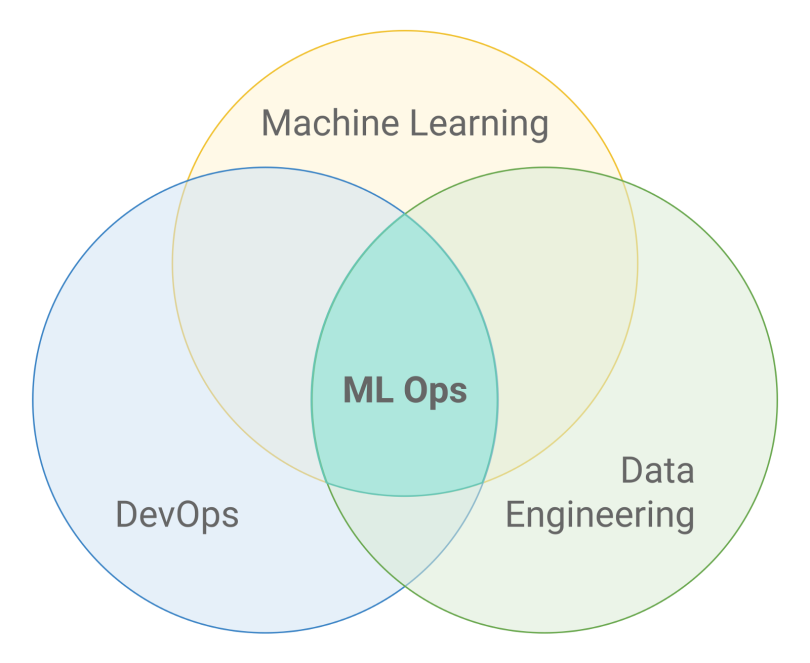
In our fast-paced digital world of 2025, businesses are leaning heavily on Artificial Intelligence (AI) and Machine Learning (ML) to stay ahead. Think about how apps recommend movies or predict traffic – that’s AI at work. But creating these smart systems isn’t enough; they need to run smoothly and update quickly. That’s where MLOps (Machine Learning Operations) meets DevOps (Development Operations). MLOps adapts DevOps principles – like automation and teamwork – to handle the unique challenges of ML, such as dealing with huge datasets and retraining models. By converging them, companies build one seamless platform for both software and AI, making everything more efficient and scalable.
Why Converge MLOps and DevOps?
Merging these practices helps teams deploy AI faster while keeping things reliable. Benefits include quicker updates, fewer errors, better resource use, and easier scaling for big AI projects. As AI grows – with the MLOps market hitting $3 billion by 2025 – this convergence is key for handling complex tools like generative AI and autonomous agents.
Key Aspects of Convergence
The blend of MLOps and DevOps isn’t just about tools; it’s about creating a unified workflow. Here are the main aspects:
- Unified Pipelines and Automation: DevOps’ continuous integration and delivery (CI/CD) now include ML steps like data processing and model training. This automates everything from code to AI deployment, reducing manual work and speeding up releases.
- Scalability and Infrastructure: AI needs heavy computing power. Convergence uses DevOps tools like Kubernetes to manage resources dynamically, supporting massive data and models without downtime.
- Governance and Monitoring: ML adds risks like biased models or performance drops. Integrated systems use DevOps monitoring (e.g., for alerts) with ML-specific checks for fairness and drift, ensuring compliance in industries like finance or healthcare.
- Collaboration and Culture: Breaks down silos between data scientists and engineers. Teams share platforms, adopting agile methods to experiment and iterate quickly.
- Integration with Emerging Tech: Extends to LLMOps (for large language models) and AgentOps, creating “XOps” for advanced AI like predictive and generative systems.
These aspects help overcome challenges like adoption hurdles in enterprises, where MLOps builds on DevOps lessons for smoother AI operations.
Industry Case Studies
Real companies show how this convergence works in practice. Here’s a look at some standout examples from 2025 trends:
- Netflix: They integrate DevOps for their streaming infrastructure with MLOps for recommendation engines. Using tools like MLflow and Kubernetes, they automate model retraining on viewer data, serving personalized content to millions. This has cut deployment times and boosted user engagement.
- Uber: Their Michelangelo platform merges DevOps CI/CD with MLOps for ride forecasting and pricing. It handles real-time data, automated testing, and scaling across global operations, improving accuracy and reducing costs.
- Google: As pioneers, they use Vertex AI to fully automate MLOps within DevOps frameworks. For services like Search and Ads, this enables rapid model updates on petabyte-scale data, with built-in governance for ethical AI.
Other cases, like in manufacturing, show MLOps optimizing industrial processes alongside DevOps for software, leading to predictive maintenance and efficiency gains. Enterprises learn from these to scale ML, focusing on hybrid teams and tools.
Google’s MLOps Maturity Model: A Roadmap to Improvement
Google’s model rates your ML setup on automation levels, from basic to advanced. It helps teams progress toward efficient AI operations.
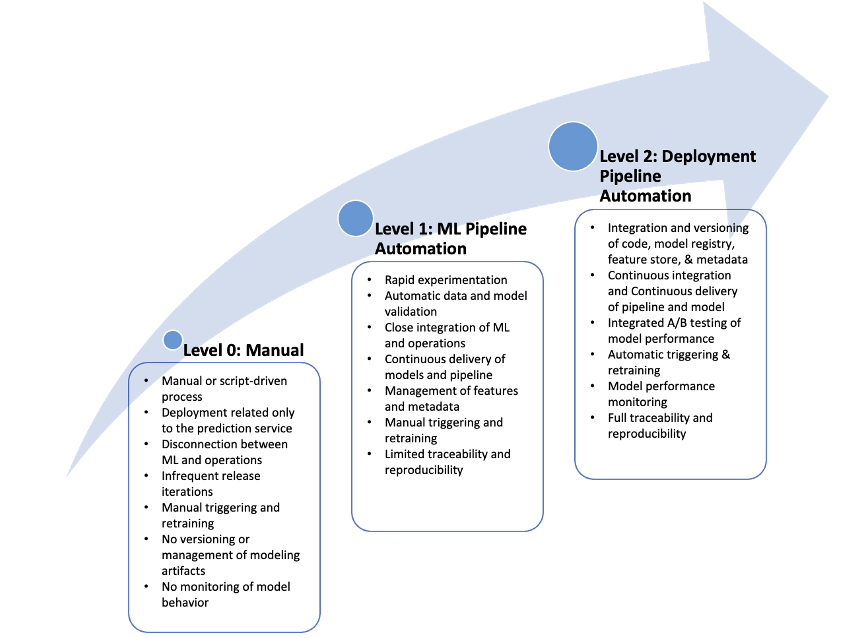
| Level | Name | Description | Key Features | Example |
|---|---|---|---|---|
| 0 | Manual Process | All steps are hands-on, like notebooks for experiments. | No automation; prone to errors. | Small teams prototyping simple models. |
| 1 | Pipeline Automation | Automates training and deployment on new data. | Continuous training; reproducible. | E-commerce retraining recommendations weekly. |
| 2 | Full CI/CD Automation | Automates everything, including code changes. | Fast iterations with monitoring. | Tech giants like Uber updating models daily. |
Aim to climb levels for better speed and reliability.
Roles of Stakeholders in MLOps and DevOps Convergence
Success relies on everyone pitching in:
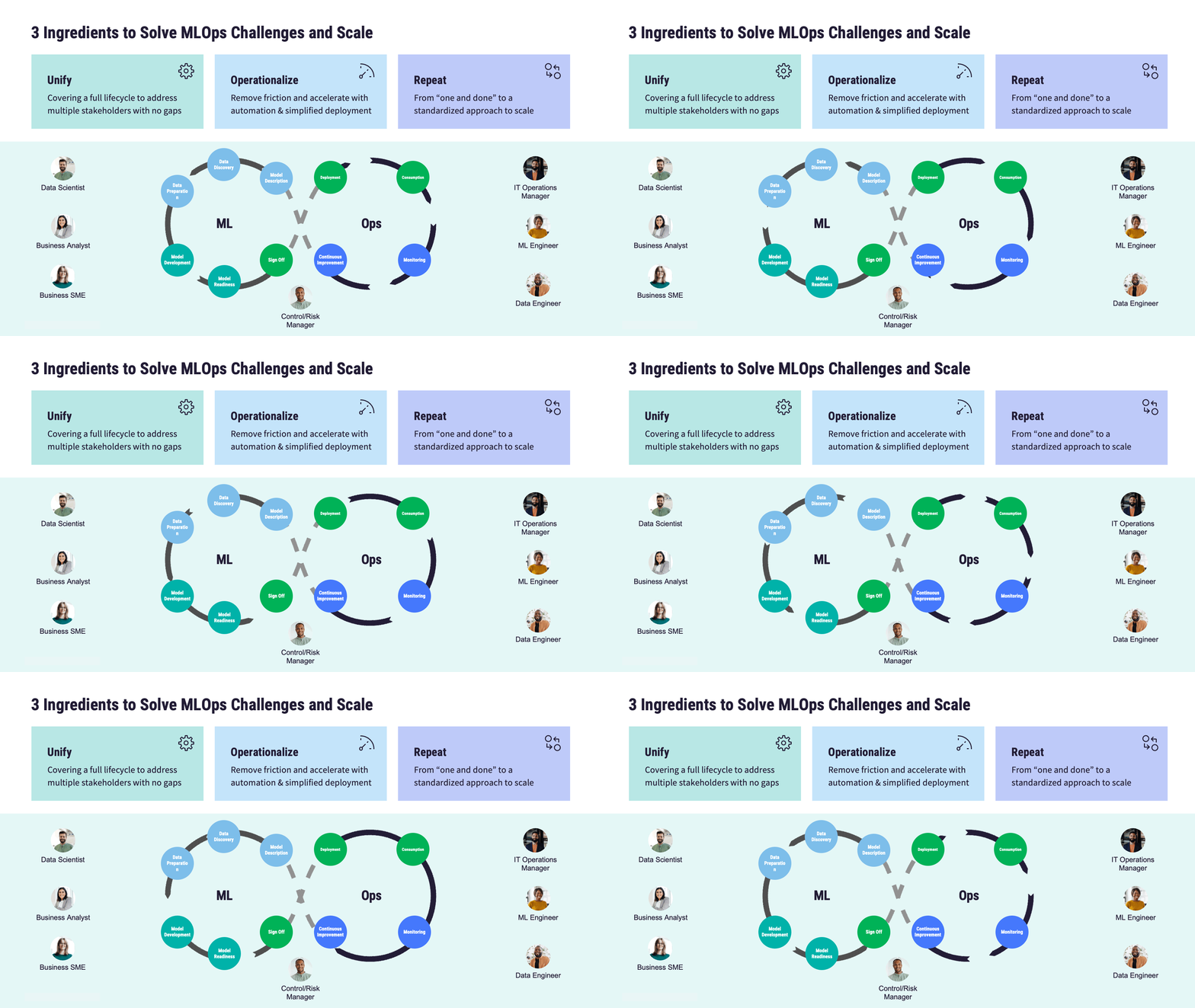
- Data Scientists: Experiment and build models, focusing on innovation.
- ML Engineers: Optimize models for production and automate workflows.
- DevOps Engineers: Manage infrastructure, pipelines, and scaling.
- Data Engineers: Ensure clean data flows reliably.
- Business Leaders: Set goals and track ROI.
- Security Teams: Handle risks like data privacy.
A DevOps architect often guides the merge, promoting shared tools.
Best Practices for Building Unified Platforms
- Automate End-to-End Pipelines → Cover data ingestion to monitoring. Why? Cuts manual errors and speeds releases from months to days. How? Use Kubeflow or Airflow integrated with Jenkins/GitHub Actions; trigger retraining automatically.
- Version Everything → Track code (Git), data (DVC), models, and environments (Docker). Why? Ensures reproducibility—if a model fails, roll back easily. How? Store artifacts in a registry for full traceability.
- Monitor Model Health Continuously → Watch accuracy, drift, and latency beyond infrastructure metrics. Why? Models degrade over time; early detection prevents issues. How? Tools like Prometheus for basics, plus Evidently for drift alerts.
- Foster Strong Collaboration → Build self-service platforms. Why? Reduces silos and bottlenecks. How? Adopt internal platforms like Backstage; hold cross-team reviews.
- Incorporate Governance and Security Early → Embed bias checks and access controls. Why? Builds trust and meets regulations. How? Automate approvals in pipelines; use tools for fairness audits.
- Start Small and Scale → Pilot one project first. Why? Minimizes risks and shows quick wins. How? Assess maturity, choose open-source tools, then expand.
Conclusion: Unleash the Future of Intelligent Innovation
As we close 2025, converging MLOps and DevOps isn’t just a trend—it’s the launchpad for AI that transforms businesses and lives. By uniting teams, automating wisely, and scaling boldly, you’re not just deploying models; you’re unlocking endless possibilities. Embrace this convergence today, and watch your organization soar into an era where AI dreams become everyday reality. The future is unified—make it yours!